My workshops have seen the whole range of people on the line: employees of the VKB bank in Linz as well as kids and families at the Alpine Club (Alpenverein) in Mondsee. From bank employees to primary-school kids, the groups could hardly be more different. And yet something similar happens in every workshop: people help each other, laugh about their own wobbles and celebrate every step together.
In this post I’ll explain how a workshop works, who it’s for and what research says about balance training and learning together.
Who is a slackline workshop for?
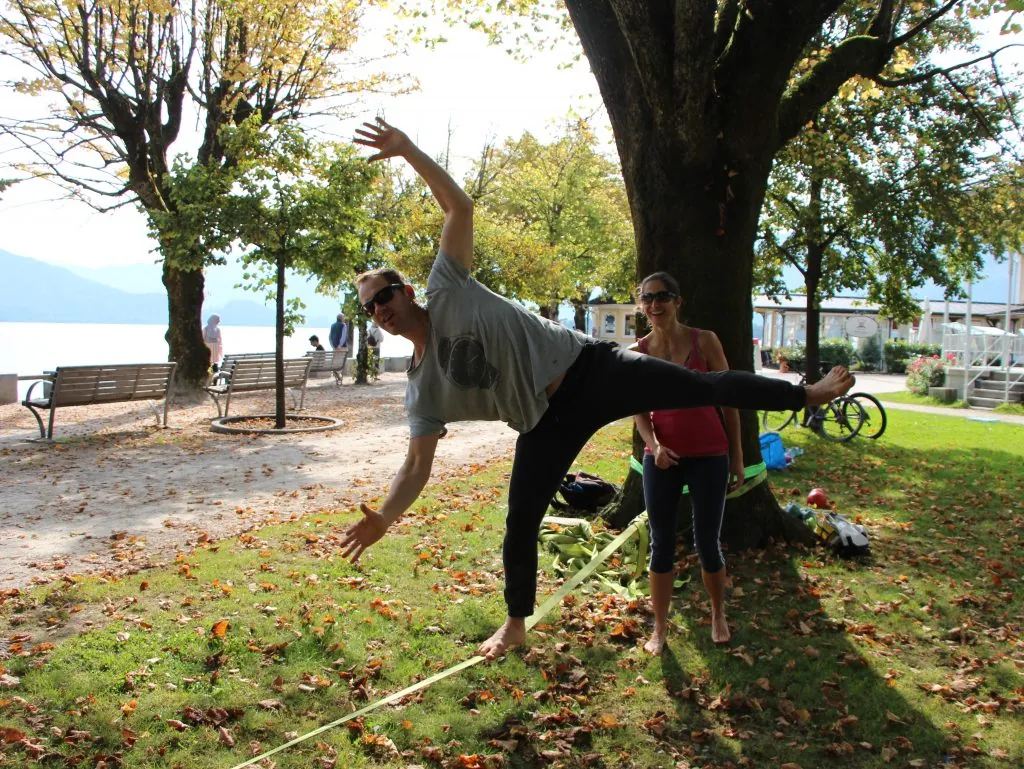
Almost everyone. That’s exactly what makes it so versatile:
- Kids and school classes who train balance and concentration through play.
- Beginners of any age standing on a slackline for the first time.
- Advanced slackliners taking their first steps towards highlining or wanting to learn their first tricks.
- Seniors who want to train their balance and help prevent falls.
- Companies and teams who want to experience something new together, as a team-building event or as part of a company party.
How a workshop works
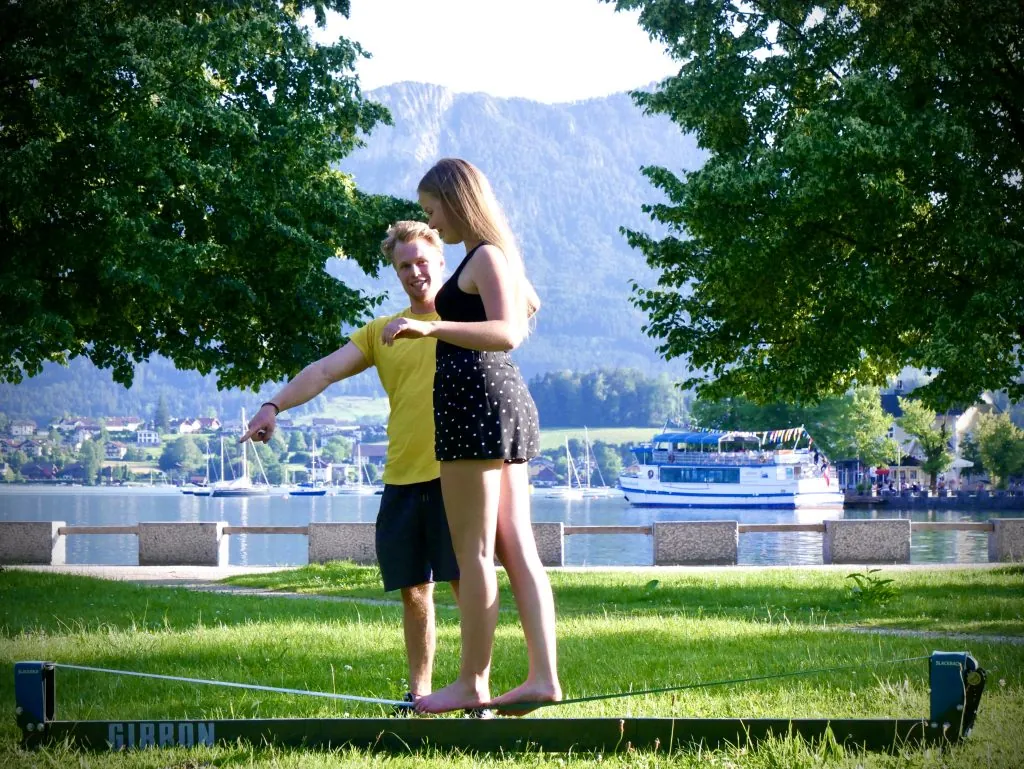
A workshop usually lasts 1.5 to 2 hours. I adapt the content and pace to the group: with kids, playful trying out comes first; with advanced participants, it’s about technique and first tricks. If there are no suitable trees, I bring a Slackrack so we can get started almost anywhere. You can read more about the Slackrack in my comparison Slackboard vs. Slackline.
The basics we practise are summarised in How to Slackline for Beginners.
Why slacklining works for team building
On a slackline, everyone starts from zero. The boss wobbles just like the apprentice, which instantly takes any hierarchy out of the situation. Nobody manages the first steps alone, so people naturally offer each other a hand.
On top of that comes a lesson I learned through slacklining that’s worth a lot at work too: don’t let falling discourage you. Everyone falls off, and that’s exactly why you get back on.
Research also offers some hints as to why shared experiences like this bring people together:
- In a study by Bastian and colleagues (2014), groups of strangers who went through a mildly painful task together (such as holding their hands in ice water) felt more bonded to each other. They also cooperated more afterwards than groups who did the same task without pain.
- Wiltermuth and Heath (2009) showed that people who had moved in sync, for example by walking in step, cooperated more in group games afterwards.
To be fair, these were short lab experiments, not studies of company teams on a slackline. But they show why a shared experience outside the comfort zone can connect people more than yet another meeting.
Balance as a health topic
Balance sounds like sport, but it’s above all a health topic:
- Around one in three people over 65 falls at least once a year, and among people over 80 it’s almost one in two (German Geriatrics Society and German Society for Orthopaedics and Trauma Surgery, 2020).
- It matters at work too: in Germany, around one in five reportable workplace accidents is a slip, trip or fall (DGUV, 2015 data).
- Targeted balance and functional training reduces the rate of falls in older people by around 24 percent, according to a large Cochrane review (Sherrington et al., 2019).
So what does slacklining specifically do? Studies show that slackline training clearly improves balance on the slackline itself. The effect on other balance tasks is smaller, but present (Donath et al., 2017). In a study with older adults, six weeks of slackline training improved, among other things, how long participants could stand on one leg (Thomas & Kalicinski, 2016).
To be honest: a single workshop isn’t a health programme and doesn’t replace regular training. But it’s a really good, motivating start, especially for people who don’t enjoy classic balance exercises. If you want to keep going afterwards, you can continue at home, for example with a Slackboard.
Workshop or show?
The two can also be combined. At company parties I often pair a show with a hands-on station where guests can step onto the line right afterwards. You’ll find more ideas in Corporate Event Entertainment Ideas.
Want a workshop for your team, school class or club? You’ll find all the details on my slackline workshops page, or you can contact me directly.
Sources
- Bastian, B., Jetten, J. & Ferris, L. J. (2014). Pain as social glue: Shared pain increases cooperation. Psychological Science. doi:10.1177/0956797614545886
- Wiltermuth, S. S. & Heath, C. (2009). Synchrony and cooperation. Psychological Science, 20(1). doi:10.1111/j.1467-9280.2008.02253.x
- Sherrington, C. et al. (2019). Exercise for preventing falls in older people living in the community. Cochrane Database of Systematic Reviews. doi:10.1002/14651858.CD012424.pub2
- Donath, L., Roth, R., Zahner, L. & Faude, O. (2017). Slackline training (balancing over narrow nylon ribbons) and balance performance: a meta-analytical review. Sports Medicine. doi:10.1007/s40279-016-0631-9
- Thomas, M. & Kalicinski, M. (2016). The effects of slackline balance training on postural control in older adults. Journal of Aging and Physical Activity. doi:10.1123/japa.2015-0099
- DGG & DGOU (2020). Joint press release, 10 March 2020. dggeriatrie.de
- DGUV (2017). Fact sheet on slip, trip and fall accidents. dguv.de