Setting up a slackline isn’t rocket science. But a few small details make a big difference: the line runs straight, the tree stays protected and, above all, nothing can go wrong. In this guide I’ll show you how I set up a slackline and share the tips I also give in my workshops.
What you need
- A slackline set with a ratchet. For beginners I recommend a wide 5 cm line, for example the Gibbon ClassicLine Set.
- Tree protection for both trees. It’s already included in most slackline sets, for example the ClassicLine Set. You can also buy it separately, such as the Gibbon Treewear.
- Something for a backup: a separate sling, a strong rope, an old slackline or simply the leftover webbing coming out of the ratchet.
- Two healthy, sturdy trees at a suitable distance.
How to set up a slackline in 5 steps
1. Put on the tree protection
First, wrap the tree protection around the tree. It protects the bark and also keeps the line and ratchet in place so they don’t slide down the trunk.
2. Attach the line and ratchet to the trees
Put the line around one tree and the strap with the ratchet around the other. Pull the end through its own loop and tighten it. This connection is called a girth hitch.
My tip: fold the webbing into a U shape where it comes out of the loop. That way the line comes out flat instead of twisted to the side.
3. Thread the line through the ratchet and remove the slack
Thread the line through the ratchet and pull it as tight as you can by hand before you start ratcheting.
My tip: remove as much slack as possible. Otherwise the ratchet spool fills up before the line is properly tight.
4. Tension the line and close the ratchet
Now use the ratchet to tension the line until it feels right. Then close the ratchet.
5. Always back up the metal parts
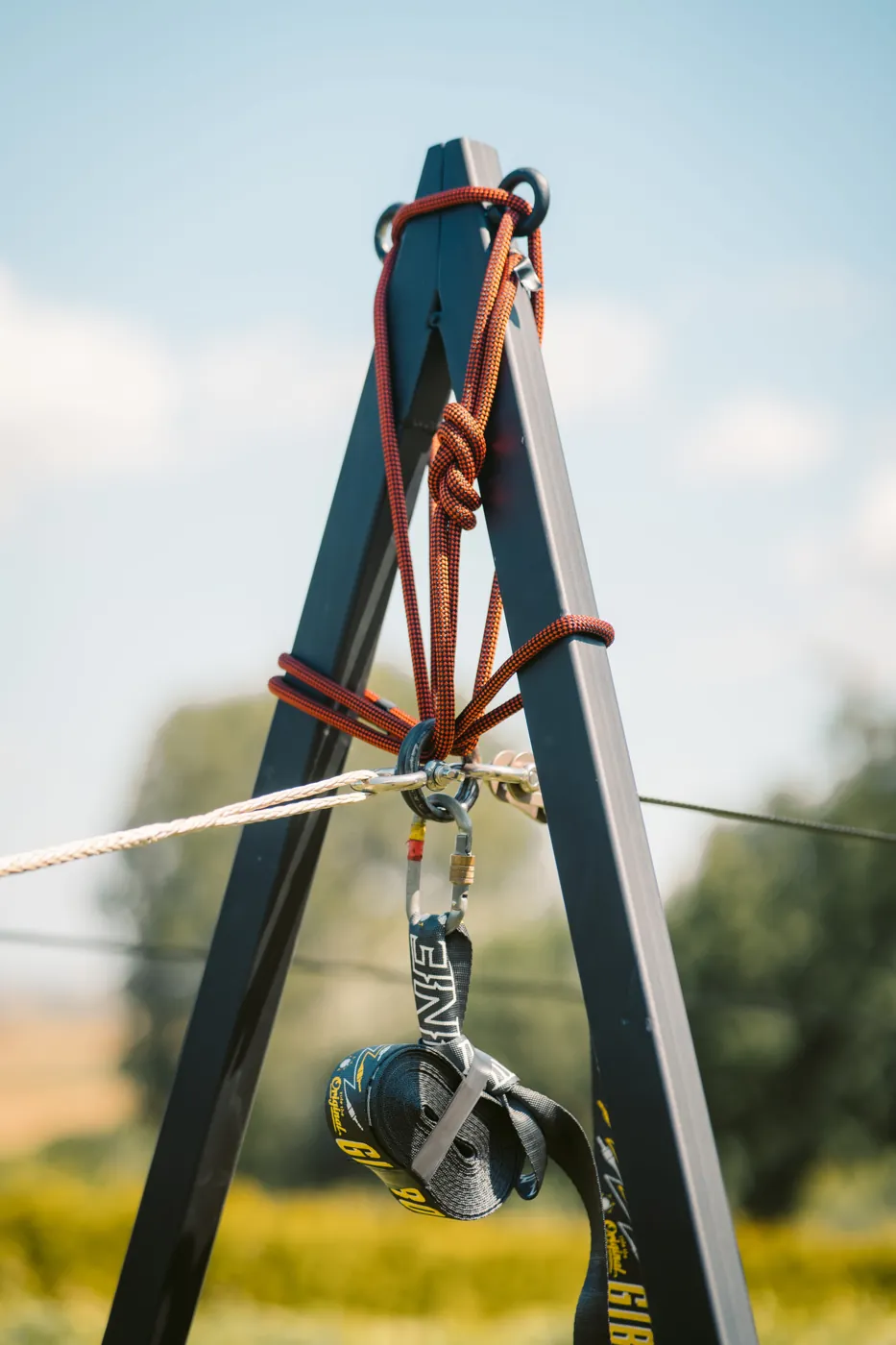
This is the most important step: back up every metal part in the setup, especially the ratchet. A separate sling, a strong rope, an old slackline or even the leftover webbing from the ratchet will do. If something ever breaks, the backup catches the line. In an emergency, that can save lives.
My pro tips at a glance
- Tree protection protects the tree and stops everything from sliding down.
- Fold the webbing into a U so the line comes out of the loop flat.
- Remove as much slack as possible before ratcheting, or the ratchet fills up too early.
- Always back up metal parts, with a sling, rope, old line or the leftover webbing.
No trees in your garden? The Slackyard
The Slackyard is a new invention from Gibbon that doesn’t need any trees at all. It can be set up in less than 30 minutes and can stay rigged in your garden all year round.
The setup follows almost the same principle as above: first screw the ground anchors into the soil and put up the A-frames. Then tension the line with the ratchet exactly as you would between trees, only without the tree protection.

Common questions
How thick do the trees need to be? Only use healthy, sturdy trees, never dead or thin trunks. As a rule of thumb, the trunk should be at least around 30 centimetres in diameter.
How high should I set up the slackline? For a start, knee height or even lower is enough. Remember that the line sags in the middle under your weight, but it shouldn’t touch the ground.
How long should a beginner slackline be? Start rather short. The shorter the line, the less it swings and the easier your first steps will be.
How tight should the slackline be? Tight enough that the middle of the line stays clearly above the ground under your weight. More tension feels calmer, less tension swings more. Try out what suits you.
Can I set up a slackline without trees? Yes. For the garden there’s the Slackyard (see above), and for workshops or indoors a frame such as the Slackrack works well. You’ll find my experience with it in Slackboard vs. Slackline.
What should I watch out for when taking it down? Open the ratchet slowly and in a controlled way, because a tensioned line holds a lot of force. Keep your hands and face out of the way.
Now: get on the line
Once the line is up, it’s time to balance. I explain how to manage your first steps in How to Slackline for Beginners. And whether you should wear shoes is covered in Slacklining With or Without Shoes.
With the code MORITZ you get 15% off all products in the Gibbon webshop.
Transparency: I work with Gibbon Slacklines. Links to the Gibbon webshop are partner links.